The Secrets of Nefertiti's Bust


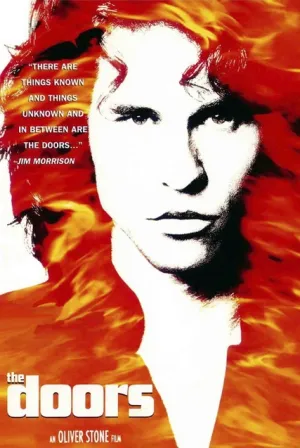
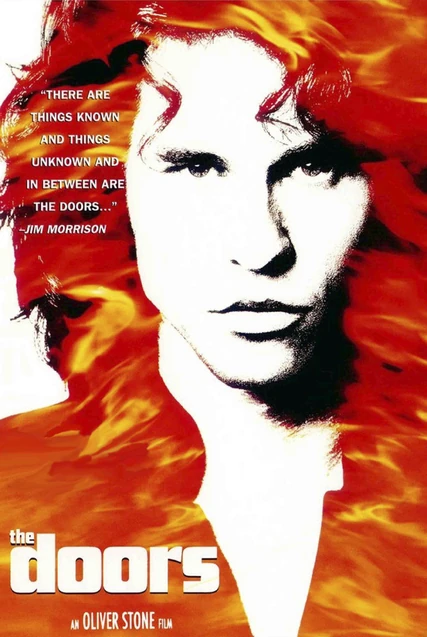
It's a bloated, pompous, unbalanced film, which looks great but has nothing going on beneath the surface. This is the biopic Jim Morrison deserved.
- Alex von Tunzelmann, The Guardian, 2011
Introduction
When The Doors was released in 1991, it was the subject of a both derision and celebration.
The film arrived off the back of Stone's JFK, Born on the forth of July, Platoon, Wall Street. these were huge films with culutral impact and controversy, and were deeply rooted in the examination of morality.
When I heard of this film I was surprised and excited at the prospect of Oliver Stone wirting and directing a film about The Doors, a band whose entire discography I was, in 1991, in the process of collecting, who I listened to at least every other day and subsequent to the film I was to visit Jim's grave in Père Lachaise Cemetery, Paris, and in 1992 spend the summer in the USA shooting on Super 8. Both of those trips inspired photos that would contribute to my first 2 photographic exhibitions. So, full disclosure, I was buzzing with excitement when I watched this film in the theatre.
Now, 35 years later, I am watching it again, perhaps with a different viewpoint, to understand better the sensations that Stone created in a few key scenes that affected me as a young student.
Whislt there are plenty of call outs to themes in Stones other works, politics, social change, anarchy, this film moves closer to the nature of thought, being, superstiton, artistic truth. After establishing the historical context, and the music, by the 25 mniute mark, we get to feel where he's going.
“How many of you people know you're alive? How many of you people know you're REALLY alive?"
Jim Morrison played by Val Kilmer in The Doors (1991)
Exploring Time and Fate
Stone expands on the Dionysian themes from Morrison's poetry, music and life. within the modern myth of Jim Morrison and The Doors, this describes something wild, irrational, ecstatic, and unrestrained, stemming from the psychedelia of that age. He also utilises multiple layers within the film.
By the time that Jim Morrison's character breaks out of his shyness and shouts from on top of cars outside Whiskey-a-go-go; "How many of you people know you're alive? How many of you people know you're REALLY alive?", we have established the main characters, the band is formed with its direction and philosphy, Jim's relationship with Pam is in place, and the music executives are handing out success cards.
It's at this juncture that for me, the film gets cinematically interesting. We get to the main theme of the film, outside just being a biopic of a rock group, or a story about excess and decadence. We get to the problem of fate.
I think in order to provoke our thought about this musical demi-god Stone is always pulling us toward The End.
Jim is set upon this path (at least in the film, and be aware that there are a number of highly disputed scenes that the band called out, notably by Ray Manzarek) when the band takes psychedlic drugs (peyote) in the desert.
While on his trip, Jim sees the past and the future, and notably his own death.
These are our most direct “dream-image” candidates. Here perception detaches from action and becomes pure optical and sound situations (opsigns/sonsigns). Instead of action (i.e. Jim walking 'towards' something) producing predictable sensory-motor links (movement-image), the film suspends action and forces thought to confront images as images.
Excerpt - at 31mins40s
Frame
We are in the desert. This is what we are being visually told, but we are about to transcend into another dimension with Jim. We know there is a greater wolrd in this film, it's the lights and glitz of Whiskey-a-go-go, from the previous scenes, it's the groups of friends getting high, and we likely know there's going be the general on going backdrop of 60's America, fame, fourtune, rock and roll and so on.
Here is where Stone establishes the desert as any-space-whatever. This according to Deleuze are non cinematic sites that begin to free us from the constraints of the typical mise-en-scene. they also act as the step from the movement-image to time-image.
As long as there is a link from action back to perception we are still dealing with the movement image. This is the case when the group of friends go to the desert, take drugs and after coaching them on their trip Jim decides to lead the group and wander off. This is still readable as action. He has a motive, (he says "I'm lying, I am afraid") and leaves.
This is the break from the action space of the group being together etc to the open desert, and moreover, the open cosmos. This is a Deleuzian move. The frame ceases to delimit an action-space and becomes an affective and / or temporal field.
It is in this any-space-whatever that Stone can host virtual images, and hence redirect our thinking.
Shot
Let's take it from the break. This is the shot of the overhead timelapse. I think it's important to note that the we are not jsut in a sympathetic state of being 'high' or hallucinating with the group. There is a distinct difference.
Even with the visual effects of the groups trip, it is still grounded in a reality. They rave, they dance, they vomit, they have fears. This is still movement-image.
Stone gives us a series of rapid, intense, and technically brilliant images to consume, in a montage that brings us (and Jim) to the cave. This shifts the audiences thinking and way of thinking. There is an:
-
Overhead time-lapse of clouds (time accelerates independently of human action).
-
Solar eclipse staged as a cosmic event that dwarfs narrative causality, and this is also time-shifted.
-
Low angle across the desert floor: human scale is displaced by a non-human timescale.
-
Crossfades and “fades-in” (native American on a horse) that don’t function as spatial continuity but as image contamination (one image regime seeping into another). Different dimensions of thought interferring.
- Sonosigns of the eagles screeches, the disembodied voices of Jim's bandmate, and mother
Stone takes us deeper than just the shift to contemplation. He wants us to contemplate something specific, and leads us to the rocky outcrop in the desert.
The montage breaks further from chronological sense. We are in part in the cave of Jim Morrison's head. The sequence then intensifies into time-image proper when it produces the irrational linkages of the red “hallway” shot (Paris overdose) as it appears as a flashforward. This is not motivated by plot information but by a temporal fold. The faces of band members fade in/out. We know they are not in the cave, and perhaps arev future verisons of themselves, their virtual presences are intruding on the present.
As the “camera soars” over the 1949 crash, we know that the camera is no longer a human observer; it becomes a free, disembodied perception. It is the eagle, is it Jim's soul, has jim become the eagle as per regional native american mythology?
[There is a lot of 'sacred' imagery here, the cathedral-like walls of the mountains / rocky outcrop, the icon of the Eagle in (South West) Native America culture, the cave as 'church'.]
Lastly, the cut to the bathroom and bathtub (Paris) interrupts the cave. This a cut that is not a rational spatial/temporal bridge. This is what Deleuze would called coexisting sheets of time that are all happening at once. (i.e Childhood, the desert, the future in Paris)
Montage
Over the course of the 2 minutes or so, until we arrive back at the Whiskey-a-go-go, there are a number of montage techniques at play.
- Time-lapse pans (cloud streaks, shadows racing up cliff faces)
-
time is no longer inferred; it is presented. The pan and timelapse together create a specific effect, it slows us down, into time itself.
-
- Crossfades / superimpositions (native American fades in; faces fade in/out)
-
not continuity devices but crystal images: actual and virtual co-present, these are from different sheets of time
-
- Soaring / “impossible” camera movement (i.e. flying over the crash)
-
-
the camera becomes a “pure seeing” and not subordinated to a character’s action.
-
this is very close to Deleuze’s opsign: perception detached from sensory-motor demands.
- flying (and embodied as the eagle) also acts as a spiritual transition, invoking death and rebirth.
-
The montage's effect
We set out on a journey with Jim, but this is not a path through space, it is a circuit through time (where the "actual image in a film links up with avirtual imagefrom memory or fantasy, creating a direct image of time that is no longer subordinate to movement or chronological succession." Deleuze Cinema 2: The Time-Image.)
Even through Jim's sets off across the desert floor eventually arriving at the cave, we are shown him sliding through sheets of time that are the (virual) past of the 1949 crash, the(virtual) future of Paris and possibly a kind of mythological eagle-time (cougars, lizards, native american, eagle).
There is not a linear chronology, this points towards a coexistance of time 'slices' or layers that the film moves between.
This is not just a cool visual montage, this is firmly, (whether Stone is actively or purposefully showing us) in the world of the philosophical understanding of time as per Bergson.
As the audience we may not know all durations, (we are not the real Jim Morrison) but every single one of these time slices that comes into existence must be related, as a part, to the others.
Stone acts as a master "butcher who knows how to cut at the articulations or the good tailor who knows how to sew pieces of cloth together into clothes that fit."
What he is proposing here instead of a typical narrative is that reality is a continuous, undivided flow, or duration, in which the past is continually being created and preserved alongside the emerging present.
Movie
Details
Cast

Val Kilmer

Kyle McLachlan

Kevin Dillon